Anglo-French Coins
| In 1066 came about a most important geopolitical happening : the
conquest of England by the Norman barons, vassals of the king of France.
In 911 Normandy was given to the Norsemen, who preferred to settle
in a rich province with a pleasant climate, rather than return to
their native countries of Denmark and Norway. At this point they agreed
to stop pillaging the shores of France and England, where, over two
centuries, they had destroyed all civilised existence, burning towns
and monasteries and slaughtering populations. In 1066, when William
the Conqueror defeated King Harold at the Battle of Hastings, they
were an integral part of the nation and spoke "French".
Moreover, the Normans, along with the Romans, were the only people
to have successfully invaded England
The towns they created had French names - at this time, Westminster was called ‘Ouestmoutiers’ – their court would accept no, or only a few, Saxons and the use of the French language was going to become so firmly anchored amongst the nobles that the motto of England " Dieu et mon Droit " is still in French as is the motto of the order of the Garter : " Honni soit qui mal y pense " |
| At this time developed the first known versions of the legend
of King Arthur, the mythical king of Brittany around 700A.D. who
was to fuel the imagination of European knights for several centuries.
The adventures of Lancelot, of Percival –Wagner’s Parzifal – of
Morgana and of Gwenovere are as familiar to us as they were to the
European nobles of the time. Of course while we can collect the
coins of all the Richards,Terrys, Othos, Raymonds, Arnolds, Bernards,
Herberts, Geoffreys or Williams who heard the legend , there are
no coins of the heroes of the age of King Arthur.
Marriages between inhabitants of the two sides of the channel were numerous and the cause of many wars; a conflict came about when the king of England, grandson of the King of France, claimed the French throne. Moreover, it is to be noted that if Joan of Arc had not intervened and if the English branch of the Royal French Dynasty had remained in power in France, all the countries which presently speak English, would speak French. France, at the time had 20 million inhabitants, as compared with 8 million in England and the lasting political alliance between the two nations, under the direction of an exclusively French nobility, would have probably left the English language only to the English peasantry . The ‘United States of America’ would be called ‘Les Etats Unis d’Amérique ‘ Saint Louis died of the plague just outside Tunis in 1270 at a time when the difficulties between France and England were still going on and were about to degenerate rapidly into open warfare . When ‘Philippe le Bel’ in 1299 gave his daughter, Isabelle, in marriage to Edward, the son of the Plantagenet king Edward I , he was unaware of the fact that his family was to be struck by a curse which would deprive it of male descendants. The legend would have it that he was cursed by Jacques de Molay, Grand Master of the Order of the Temple, when he was about to be burned at the stake. The king had condemned him to death to steal the riches of the Order and destroy his power. It is true that those who brought about the destruction of the ‘Order of the Temple’, the king, his finance minister, Nogaret, and Pope Clement were all to die within a year, but the saddest thing is that the sons of Philippe le Bel were to die successively without leaving any heirs. Isabelle, the ‘She-wolf’ of France, eliminated her husband, placed her son Edward III on the throne and arranged for him to marry ; the English branch had descendants and Edward III claimed the crown of France. This is an extremely rich period for numismatics ; we have French royal coins, Anglo-French coins struck by the kings of England in France and all the feudal coins struck under one or other of the suzerainties, according to the victories or defeats. Both royal series include some marvellous gold coins and some very nice silver coins as well as some ‘black’ coins in poor-quality silver. These latter coins were particularly in circulation, amongst the common people, the silver coins being reserved rather for rich peasants and for the bourgeoisie whereas the gold coins were used by the nobility and by the Bank, which was beginning to develop under the influence of the big Lombardy families. |
![]() |
A ‘Blanc aux ecus ‘ of Henry VI Struck at Rouen in Normandy. Estimated at : 1 200 FRF
|
![]() |
A ‘Gros’ of Henry VI Struck at Calais Estimated at : 1 000 FRF |
| Silver coins are to be found for the sum of two hundred francs
(forty dollars) and more, with the most exceptional examples, in
the Anglo-French series, which are by far the most sought after,
attaining ten thousand francs. The Duncan Elias collection, which
served as a reference in this field, has been dispersed.
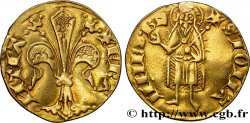
The royal French gold coins of this period, start at one thousand, five hundred francs (three hundred dollars). The Franco-English gold coins –‘ Leopards’, ‘Nobles’ and ‘Saluts’ – are far more rare and far more expensive, starting at five thousand francs (one thousand dollars). The reference book for the English coins is ‘Anglo-Gallic coinage’ by Duncan Elias and for the French coins, any works by Jean Duplessy. There is no existing reference collection and that of the National French Library (BnF) is far from complete, except for type coins. There are about thirty different mints, for example Paris, Lyons Mâcon, Toulouse, Bourges… which explains the difficulty of constituting a global collection. Coin-collectors generally choose to collect coins of a certain type, coming from the mints of a certain region or even from just one mint. The hundred-year war between the two branches of Philippe le Bel’s family, claimants to the throne of France, was only to end long after the intervention of Joan of Arc but it was she the driving-force, being perhaps the first person to stress the idea of the ‘nation’ an idea dominant in the 19th and 20th centuries. The idea of a country, a people, a king, taking over from the feudal structures and intermediary powers was radically new for its time. |
What are French coins ?
/ Celtic Coins
/ France
under the Roman Empire / The Barbaric Ages
/ Charlemagne
/ The First Royal
Coins / Les monnaies féodales
/ Anglo-French Coins
/ Les monnaies des Croisades
/ Renaissance
coins / Medals
and Jetons / Coins
of the Louis Kings / The Révolution
/ Napoléon / Les monnaies napoléonides
/ Le XIXe siècle
/ Les essais
/ The early 20th
century / Recent
French Coins / Half
of the History of Humanity / Making
a Start
![]() |